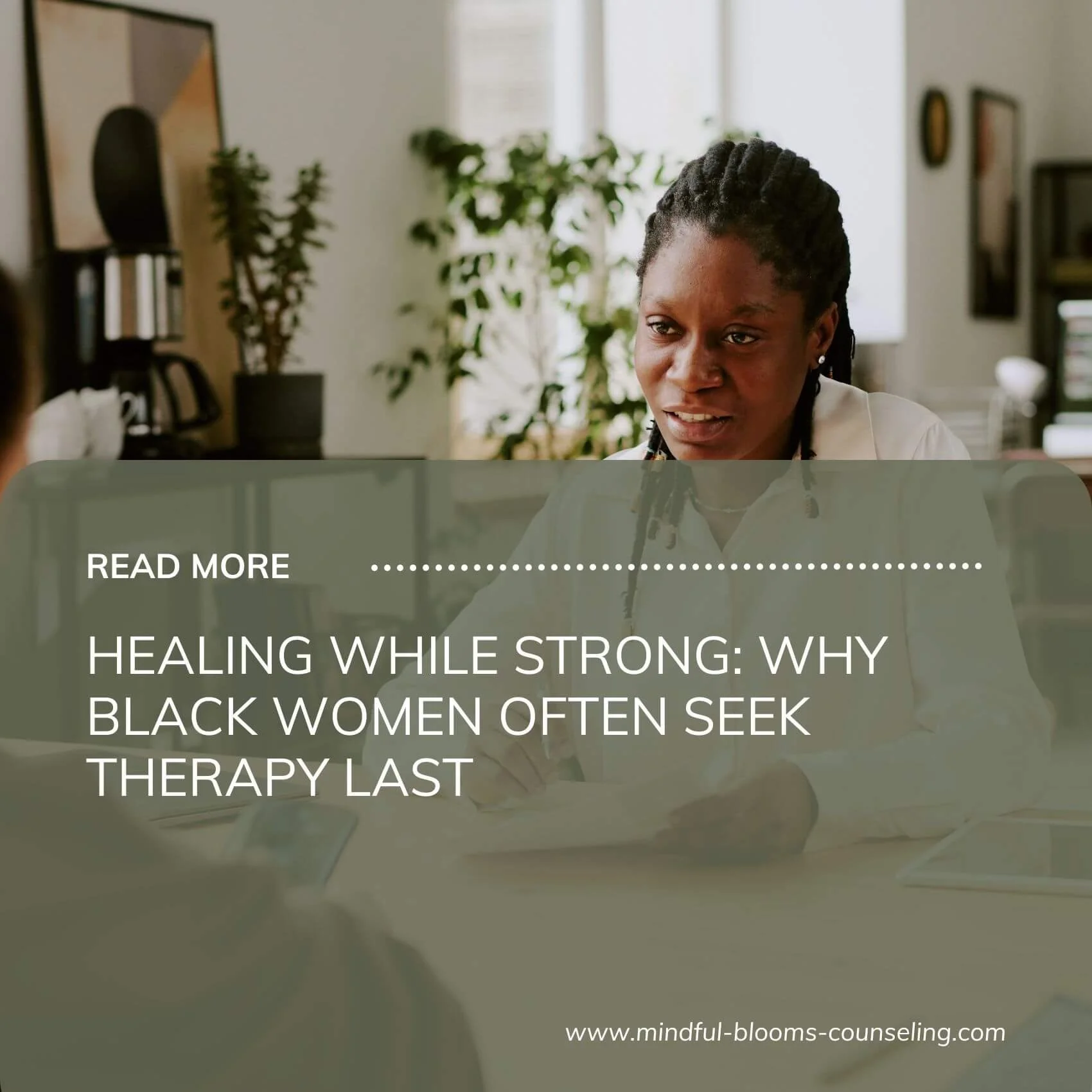
Healing While Strong: Why Black Women Often Seek Therapy Last
Trying to heal while strong has always been a survival skill for Black women. Strength is how we show up, provide, lead, and endure. Black women are taught to be strong long before we’re taught how to rest. But being strong doesn’t mean you don’t need support.
Black women often seek therapy last instead of making it their first stop. As a therapist licensed in Florida, I often work with Black women who delay seeking support until they are deeply worn down by stress, expectations, or repeated hurt. It’s almost always the last resort, which only gets reached after carrying far too much alone and when they’ve reached their breaking point.
It may lead you to wonder, “Why do we reach out for help only after we’re already breaking?”
In this blog, we’ll explore how we’ve been conditioned to see vulnerability as a weakness. We’ll break down the ways this “strength” can cause more harm than good, and we’ll explore what life can look like when you realize that being vulnerable is the exact thing that allows you to heal.
The Story Behind Being “Strong”: How Black Women Learn to Carry Everything
Have you ever noticed that we learn strength by watching the women before us? Mothers, grandmothers, aunties- they handled everything, rarely showing cracks. It’s not that they didn’t feel pain; they just didn’t let anyone see it.
From an early age, we learn that resilience isn’t optional. Generational conditioning teaches Black women to survive first and care for themselves later. And it’s understandable why this happened. For decades, our families have modeled perseverance in the face of systemic challenges. It was vital. Although this conditioning fosters resilience, it can also delay the recognition of personal needs and the pursuit of healing.
Being the strong one often goes hand in hand with faith and community. Many religious communities emphasize selflessness and caretaking. While these values foster connection and moral grounding, they can also normalize emotional suppression.
We can’t talk about being taught to be strong without acknowledging the trauma we’ve had to survive for generations. When trauma isn’t acknowledged, it doesn’t disappear. It just finds new ways to show up. Intergenerational trauma often shows up as emotional restraint, hyper-independence, or difficulty asking for help. When trauma is passed down without being addressed, these patterns become normalized. Healing begins when silence is replaced with understanding, conversation, and compassion.
Why Therapy Comes Last: Systemic & Social Barriers
Historically, mental health systems have not always been safe or affirming spaces for Black women. Barriers to therapy can include:
Lack of Representation
Historically, therapists didn’t look like us
Fear of being misunderstood or pathologized
The emotional labor of explaining identity in the session
Functioning as a Measure of Wellness
High-functioning anxiety, perfectionism, and overworking
Waiting until burnout, breakdown, or crisis
Mistrust of Mental Health Institutions
Medical racism
Stories passed down that reinforce silence
Fear of vulnerability being weaponized
The Image of Strength in Professional Spaces
Microaggressions, code-switching, being “the only.”
The emotional toll of performing competence at all costs
When you look at all the barriers black women have in front of them, it makes sense why therapy can become a last resort. These messages can make women feel as though therapy is unnecessary or even like a betrayal of faith and responsibility.
The Cost of Delayed Healing
Delaying healing doesn’t make pain disappear; it teaches it where to hide. When healing is delayed, pain becomes normalized, and rest feels undeserved.
Black women often learn to tolerate emotional strain far beyond what is healthy, mistaking endurance for resilience, which leads to high-functioning burnout. On the outside, everything appears fine, but internally, there is fatigue and emotional depletion.
It impacts relationships, too. Over time, unaddressed stress can make it harder to receive support, trust others, or express emotional needs. When you’re used to being the strong one, vulnerability can feel unfamiliar, and closeness may feel more draining than filling.
Too often, Black women are taught to push through discomfort, but the body keeps track of what you’re ignoring long after we’ve told ourselves we’re fine. Over time, this can dim joy, limit connection, and make suffering feel like a personal failing instead of a signal for support.
Healing While Strong: Letting Go of Survival Mode
Healing doesn’t require you to stop being strong. It asks you to stop ignoring what you’re feeling so that strength can have new meaning.
In my practice, I show Black women that therapy can be a space to release survival-based coping and practice a fuller, more sustainable version of resilience. A place where they can step out of survival mode and into self-trust. Instead of constantly bracing for what’s next, therapy offers tools to slow down, process emotions, and respond rather than react.
Through healing, you can be capable and still be cared for. Healing happens when you finally allow yourself to be held and reject the idea that self-sacrifice is the highest virtue, and you begin to embrace emotional well-being as a form of resistance and self-preservation.
Healing also happens in relationships. It’s common for Black women to have learned to carry pain quietly; therapy can reconnect you to yourself and to others in more authentic ways. Leaning into community means that support can become shared, and community can once again be a place of restoration.
What It Looks Like to Seek Therapy Before a Crisis
Seeking therapy before a crisis means choosing not to wait until you’re depleted. It’s scheduling support while you still have the clarity and energy for it.
Seeking therapy before a crisis begins with giving yourself permission. Permission to ask for help without having a “good enough” reason.
Noticing early signs doesn’t mean something is “wrong” with you. Sometimes the first signs aren’t dramatic. You may feel constantly tired, more irritable than usual, or emotionally checked out, even when life is going well on paper. These small shifts are often early signals that your mind and body need support, not something to push through.
By going to therapy early, you get to make decisions that are aligned with your values and goals instead of just going with the first person who’s available. This allows you the space to figure out what really works for you without rushing into something because you feel like your life is falling apart.
How Mindful Blooms Counseling Supports Black Women
At my practice, Mindful Blooms Counseling, Black women are not an afterthought. Therapy sessions are designed with an understanding of how race, culture, and lived experience shape emotional well-being. My sessions create space to explore racial stress, generational patterns, and identity, so you don’t have to explain yourself or minimize your experiences here.
Together, we work to unlearn survival-based patterns and practice new ways of caring for yourselves. My clients are guided in developing emotional awareness and healthier relationship patterns through sessions that are collaborative and focused on helping you meet your goals.
You Don’t Have to Break to Heal
Your resilience has gotten you this far, but it doesn’t have to be the only way you survive. You’ve spent a lifetime being the strong one. Now, imagine strength that rests, heals, and grows.
You deserve care, understanding, and healing without having to hit a breaking point first. If you’re in Orlando or anywhere else in Florida and ready to find healing and support through therapy, I’m here to help. Mindful Blooms Counseling is a Florida-based therapy practice for ambitious women who struggle with self-doubt, burnout, or anxiety.
If you’re tired of carrying everything by yourself, you don’t have to anymore. Therapy can be the space where you finally exhale. Book a free consultation and take the next step toward healing.
It’s okay to want your life to feel different. Wanting more ease, more peace, or more room to breathe doesn’t mean something is wrong with you. Whether you take action today or simply sit with that truth, letting yourself explore what healing can look like is a huge step in the right direction.